The Signal
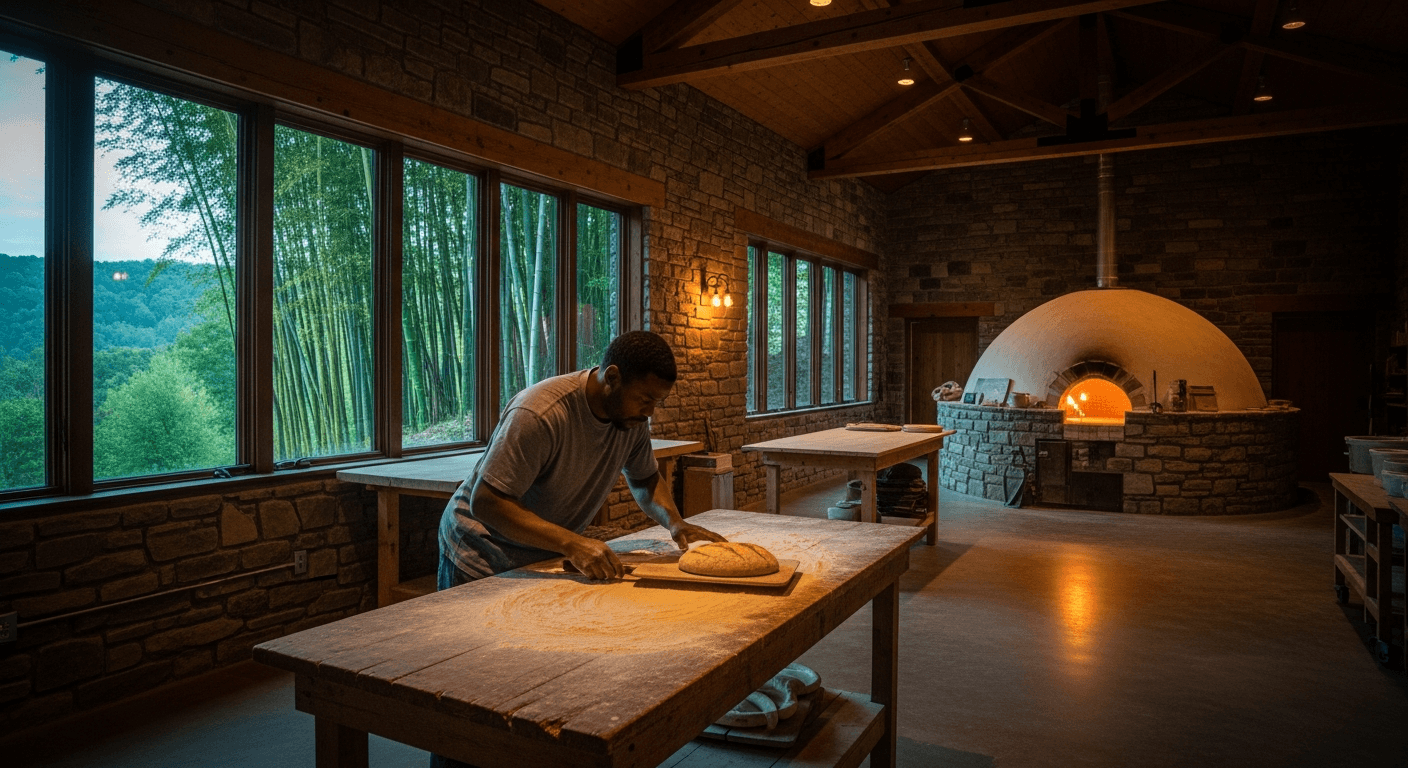
Shangwang Village, Zhejiang Province. A rural auditorium built in the 1970s to support Nixon's visit to China. Bamboo groves on three sides, farmland on the fourth. The building sat in a kind of political-historical amber for fifty years. Then a bakery brand called Cycle&Cycle showed up, acquired the usage rights, and handed the renovation to two studios: FANAF for the shell and landscape, Tens Atelier for the interior.
The result is a stone-kiln workshop restaurant. And the design move that makes it worth paying attention to isn't the food program or the brand story: it's what the studios chose not to do.
The Design Lesson
There's a version of this project that goes predictably wrong. Strip the auditorium down to raw concrete. Add Edison bulbs and open shelving. Call it 'industrial heritage revival.' It would photograph well and feel like every other reclaimed-structure restaurant from Brooklyn to Berlin.
Tens Atelier went a different direction. They kept the building's weight: the proportion of a collective-era rural auditorium is not the proportion of a boutique restaurant, and they didn't force it to pretend otherwise. The stone-kiln program gave them permission to let the building feel like a working structure, not a staged backdrop. The bamboo grove isn't framed as scenery; it's treated as part of the material palette.
This is the harder move. Working with a building's original scale and purpose instead of retrofitting a trend onto it requires the designer to actually understand what made the structure feel the way it feels, and then amplify that instead of erasing it.
Why Atlanta Should Be Watching This
Metro Atlanta has a version of this problem. We have warehouses in Castleberry Hill and old mill buildings in Roswell and mid-century civic structures scattered across the south metro that keep getting gutted to look like whatever the current moment says they should look like. The bones disappear. The history disappears. What's left is a space that could be anywhere.
The Cycle&Cycle project is a reminder that a building with a strange specific history, even a politically loaded one, even a rural auditorium nobody thought was worth preserving, can become more interesting when you actually let it be what it is.
Not every old building in Atlanta deserves to survive. But the ones that do deserve designers willing to read the structure before they renovate it.
Thinking about a move?
Beckett Real Estate works the whole of Metro Atlanta. Tell me the address or the neighborhood and I will tell you what the house is really like, what the inspection usually finds, and what the number should be.
What is my home worth?See a cash offerSell for more with conciergeTalk to an agent nowMore articles like this