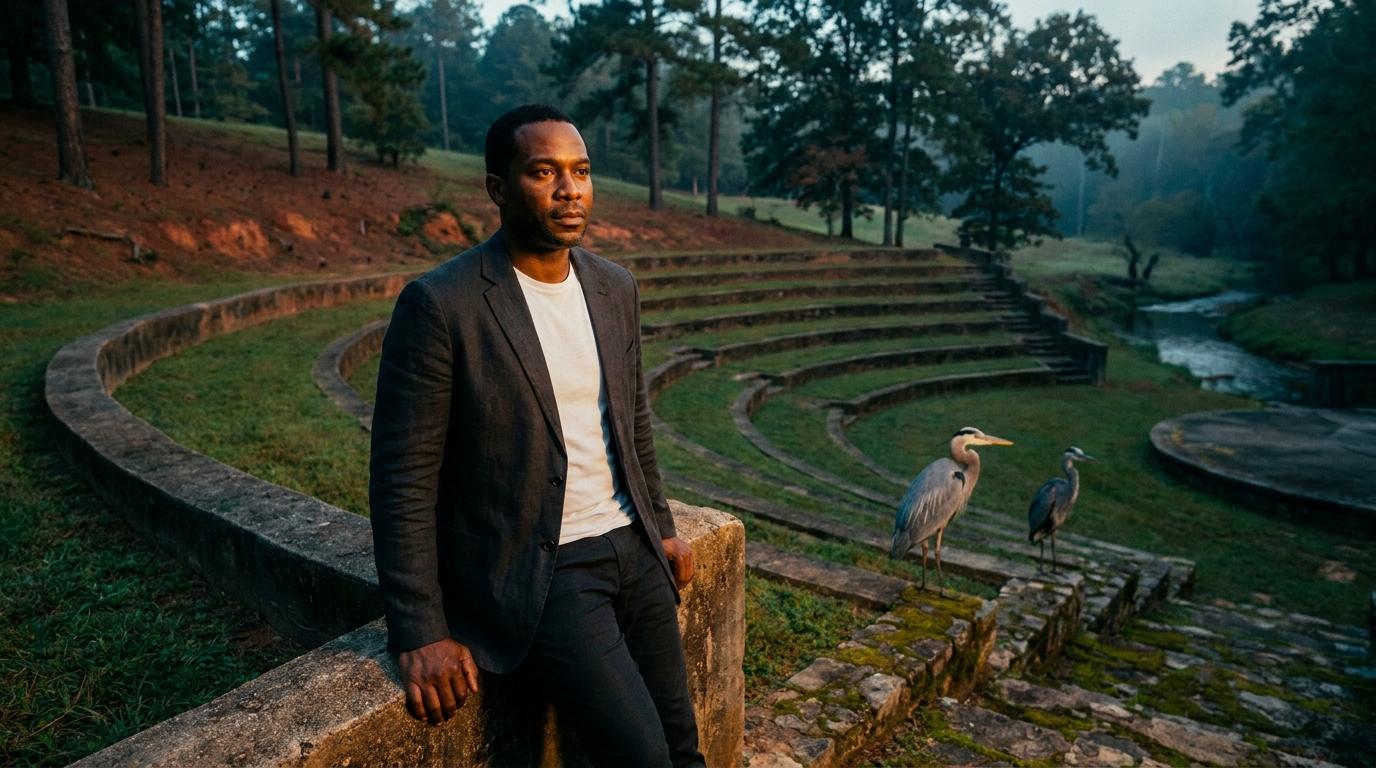
There is a theater in the Mingling Mountains outside Yixing, China (the pottery capital, if you are tracking provenance), and it was not built for people.
The Earth Valley Theater, designed by GOA (Group of Architects), is 9,200 square meters of open-air performance space dedicated to human-bird cohabitation. No enclosed aviary. No glass viewing corridors. No 'experience zone' with an admission fee. The birds move through the landscape autonomously. The humans move through alongside them. The architecture facilitates the encounter without controlling it.
That is a harder thing to build than it sounds.

What the Germans Called It — and Why That Word Matters
GOA described the project as a Gesamtkunstwerk — a 'total work of art.' Wagner used the term to argue that opera should unify music, theater, and visual art into a single coherent experience rather than treating each as a separate department. The concept never fully landed in opera. It lands here.
What GOA built is an architecture that cannot be separated from its landscape. The seating is not placed in front of a view. It is part of the topography. The performance space does not sit on the land; it is carved out of it. The sightlines are not designed for a human audience reading a program. They are calibrated to the flight paths of birds that do not know they are performing.
That is the discipline that most American commercial development abandons in the value-engineering phase. The project that started as an integrated design (where the building and the land are the same thing) becomes, by construction documents, a building sitting on a graded pad with landscaping added around the perimeter afterward. The land becomes the setting. The building becomes the subject. You lose the relationship.
I have project-managed enough ground-up work to know exactly where it happens. It happens when the civil engineer and the architect stop talking directly to each other and start throwing drawings over the fence.
The Deeper Design Principle — and What Atlanta Keeps Getting Wrong
Here is what I keep coming back to when I look at this project: the most interesting move GOA made was deciding what the building would not do.
It would not enclose. It would not control the bird flight paths. It would not create a visitor experience that required staff management, ticketing infrastructure, or maintenance contracts on a climate system. The form follows the decision to step back, and the stepping back is the design.

In metro Atlanta, the conversation about architecture and landscape integration runs about ten years behind where it should. The Westside development corridor (the stretch from Howell Mill down through the Upper Westside into the BeltLine's Westside Trail) has produced some genuinely good urbanism in the last five years. The Chattahoochee Food Works. The Works. Star Metals. These projects made deliberate decisions about how indoor and outdoor space negotiated with each other.
But most Atlanta residential development (especially the volume builders working Cherokee, Forsyth, and the Henry County growth corridor) still treats the lot as a problem to solve rather than a resource to use. Grade it flat, pour the slab, plant the mandatory three trees along the rear setback. Done.
The houses that hold their value over twenty years in this market are the ones where someone (an architect, an experienced GC, a developer who actually cared) looked at the topography first and asked what the land wanted the house to do. A walk-out basement on a sloped lot is not just a floor plan bonus. It is a relationship between the house and the grade. A covered rear porch that opens to a natural tree canopy is not a selling feature. It is an architectural decision to collaborate with the existing landscape rather than replace it.
That decision shows up in DOM numbers. Properties with genuine indoor-outdoor integration (not 'a sliding glass door and a paver patio,' but a house that actually thinks about how interior space extends into the exterior) sit on the market shorter and hold value better through down cycles. The Earth Valley Theater is an extreme example of this principle. The residential application is quieter, but the logic is identical.
The Construction Reality Behind 'Land Art'
One more thing worth saying, because most architecture journalism skips it: a project like the Earth Valley Theater is brutally hard to build.
Earthed construction (retaining structures, tiered terracing cut into natural grades, foundations that work with slope rather than fighting it) requires a level of coordination between the structural engineer, the civil engineer, the landscape architect, and the GC that most projects do not get. On a tiered amphitheater built into mountainous terrain, you are managing drainage from every direction, soil bearing capacity across multiple elevation changes, vegetation integration into structural systems, and the long-term maintenance reality of a building that will never be fully separated from rain, roots, and biological growth.
I have run projects with a fraction of that complexity and watched the coordination failures show up as expensive problems during inspections. A drain that was supposed to daylight at the toe of a retaining wall, routed incorrectly on a drawing revision, creating hydrostatic pressure behind the wall three years after turnover. A landscape grade that concentrated runoff against a foundation instead of away from it because the civil and structural drawings were not reconciled before pour.

GOA got this right. The project photographs show earthwork and planting integrated at a level that requires the landscape specification to be part of the structural package, not an afterthought. That is the mark of a project where the design team stayed together through construction, not a project where the architect signed off on design development and handed the rest to a contractor.
Why It Matters for How You Think About Your Own Property
You are probably not building a bird theater in the mountains of Jiangsu Province. But if you own a home in Peachtree City, Senoia, Ball Ground, or anywhere else in metro Atlanta with actual topography and tree canopy, the principle applies directly.
The most common renovation mistake I see on properties with genuine landscape assets is the decision to neutralize them. Flatten the slope for a bigger flat lawn. Clear the tree line for more sun on the patio. Grade out the natural drainage swale to add square footage to the backyard. Every one of those decisions trades a long-term architectural asset for a short-term convenience, and every one of them shows up as a condition or a value conversation when the property goes back to market.
The Earth Valley Theater is worth paying attention to not because you will ever build something like it, but because the design logic is transferable: figure out what the land is already doing, then build something that collaborates with it instead of overwriting it.
If you are looking at a property with topography, tree cover, or a natural water feature and want a read on whether the existing construction worked with those assets or against them, send the address. That is exactly the kind of walk-through a construction-trained eye is built for.
Thinking about a move?
Beckett Real Estate works the whole of Metro Atlanta. Tell me the address or the neighborhood and I will tell you what the house is really like, what the inspection usually finds, and what the number should be.
See homes for saleTalk to an agent nowMore articles like this