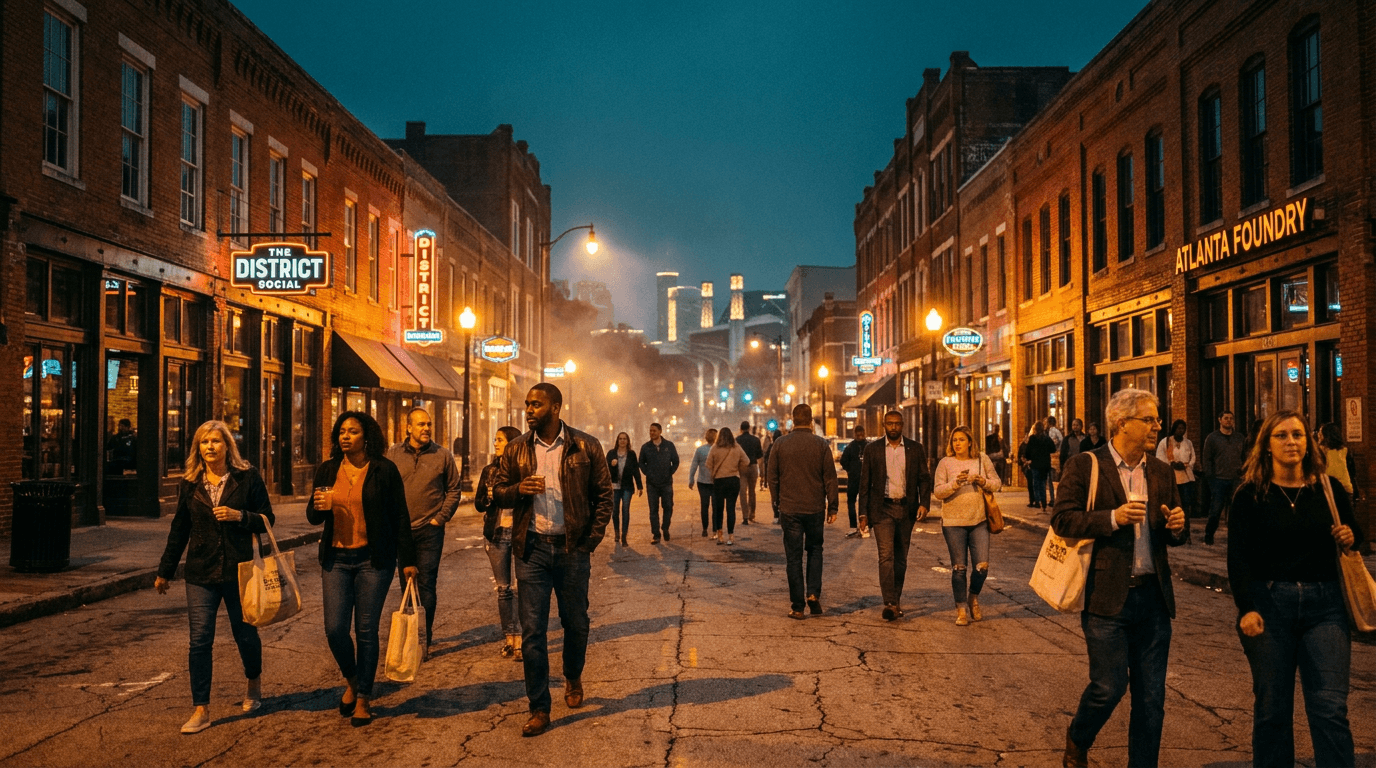
Seven days. That is what stands between South Downtown's two-and-a-half-year resuscitation project and its first real stress test: Atlanta's opening 2026 FIFA World Cup match, and every traveling fan, local, and camera crew that comes with it.
Jon Birdsong and Atlanta Ventures have been working through 58 historic structures across 16 acres south of Centennial Olympic Park, a stretch of Mitchell Street, Broad Street, and Forsyth Street that has functioned mostly as parking and potential for the better part of three decades. The push to get Certificates of Occupancy across all signed tenants before kickoff is not just a PR sprint. It is a construction and permitting sprint, which are two very different things.

What Is Actually Opening (And What the Timeline Tells You)
Here is what Birdsong confirmed as of this week: El Tesoro taqueria's third location is targeting Wednesday along Mitchell Street — though alcohol service may not be cleared in time. Glide Pizza and Brewhouse Café are aiming for Friday. 'Some form' of Broad Street BBQ could be operational by the weekend. Best case, everything opens Friday. Worst case, it bleeds into next week.
'Some form' is doing a lot of work in that sentence. In construction and permitting terms, 'some form' means the kitchen passes inspection, the hood is certified, the fire suppression triggers correctly, but maybe the bar is not plumbed yet, or the patio furniture did not arrive, or the POS system is still being configured. It is the kind of partial-open that hospitality operators know well and that nobody advertises when the press release goes out.
For the record: getting a Certificate of Occupancy in the City of Atlanta on a historic adaptive-reuse building in less than a week is genuinely difficult. Life-safety inspections on buildings this age require sign-off across electrical, plumbing, fire suppression, egress lighting, and occupant-load calculations, in structures where the original construction documents may not exist or may not reflect seventy-five years of tenant modifications. Atlanta Ventures has been running this gauntlet in parallel across multiple buildings simultaneously. That is not a small operational feat.
The Bigger Story: What South Downtown Is Actually Becoming
Zoom out from the World Cup sprint and the development picture is more interesting than the opening-week headlines suggest.
Sixteen acres of historic urban fabric, ground-floor retail activating for the first time in decades, an investor who is explicitly not flipping these buildings: Atlanta Ventures has been patient here in a way that most developers in this market are not. The portfolio play is a live-work-gather district anchored by Mitchell and Broad, within walking distance of Mercedes-Benz Stadium, State Farm Arena, the Gulch development, and the Five Points MARTA nexus.

The tenant mix that is coming online matters for what the district signals long-term. El Tesoro is not a chain. Glide Pizza is not a chain. These are local operators making bets on a street that has not had foot traffic to support them, yet. That calculus changes the moment the World Cup brings 70,000-plus fans through the stadium gates and some percentage of them walk the three blocks south to see what is down here.
From a development standpoint, here is what I am watching: whether the ground-floor activation holds post-tournament. The World Cup is a one-time demand spike. The question Atlanta Ventures has to answer over the next 18 months is whether enough organic foot traffic (residents, workers, MARTA commuters, sports fans on non-match days) can sustain these operators through the shoulder period. The answer depends heavily on what happens with the residential development pressure around Five Points and the Gulch.
What 20 Years on Jobsites Tells Me About This Build
Adaptive reuse on historic masonry is some of the most technically demanding work in commercial construction. Not because the systems are complicated, it is because nothing about a century-old building was designed for modern MEP load requirements, ADA compliance, or current fire code.
When I walked jobsites like this as a project manager and foreman, the surprises lived in three places: the electrical service (typically knob-and-tube or early Romex that cannot support a commercial kitchen load without a full service upgrade), the plumbing waste lines (cast iron that has been patching and splitting for fifty years), and the roof-to-wall interface on unreinforced masonry (the point where water infiltration has been doing quiet structural damage for decades, undetected until someone pulls the interior plaster).
None of that is catastrophic if you find it early. All of it is expensive and schedule-killing if you find it during finish work. The fact that Atlanta Ventures is running life-safety and fire inspections right now, in parallel with active fit-out, tells me they hit most of the structural surprises in the first 18 months of the 30-month build, and they are in the final permitting sprint, not discovering new problems. That is a reasonable sign that the base building work was done right.
The CO timeline pressure is real, but it is a permitting and scheduling problem, not a construction-quality problem. Those are different things. One is fixable with phone calls and inspector scheduling. The other is not.
Why This Matters for the Surrounding Market
For anyone tracking South Downtown as a real estate play — and there are buyers watching this carefully — the World Cup activation is the demand signal that either validates or delays the residential development thesis for this submarket.
The blocks immediately north (Luckie Street, Ted Turner Drive corridor toward MARTA) have been sitting in a holding pattern waiting for South Downtown to prove it can hold retail tenants. If the World Cup openings hold, and the operators are still running in Q1 2027, the residential development case for this corridor becomes significantly easier to underwrite. If the operators fade by October, the narrative resets.
Watch the tenant survival rate, not the opening-week headlines. That is the number that tells you whether South Downtown is a real neighborhood forming or a well-photographed development sprint.
Send the address if you are evaluating anything in this corridor: Beckett Real Estate looks at proximity to active retail development, building-system condition in historic structures, and submarket trajectory together, not separately.
Thinking about a move?
Beckett Real Estate works the whole of Metro Atlanta. Tell me the address or the neighborhood and I will tell you what the house is really like, what the inspection usually finds, and what the number should be.
See homes for saleTalk to an agent nowMore articles like this