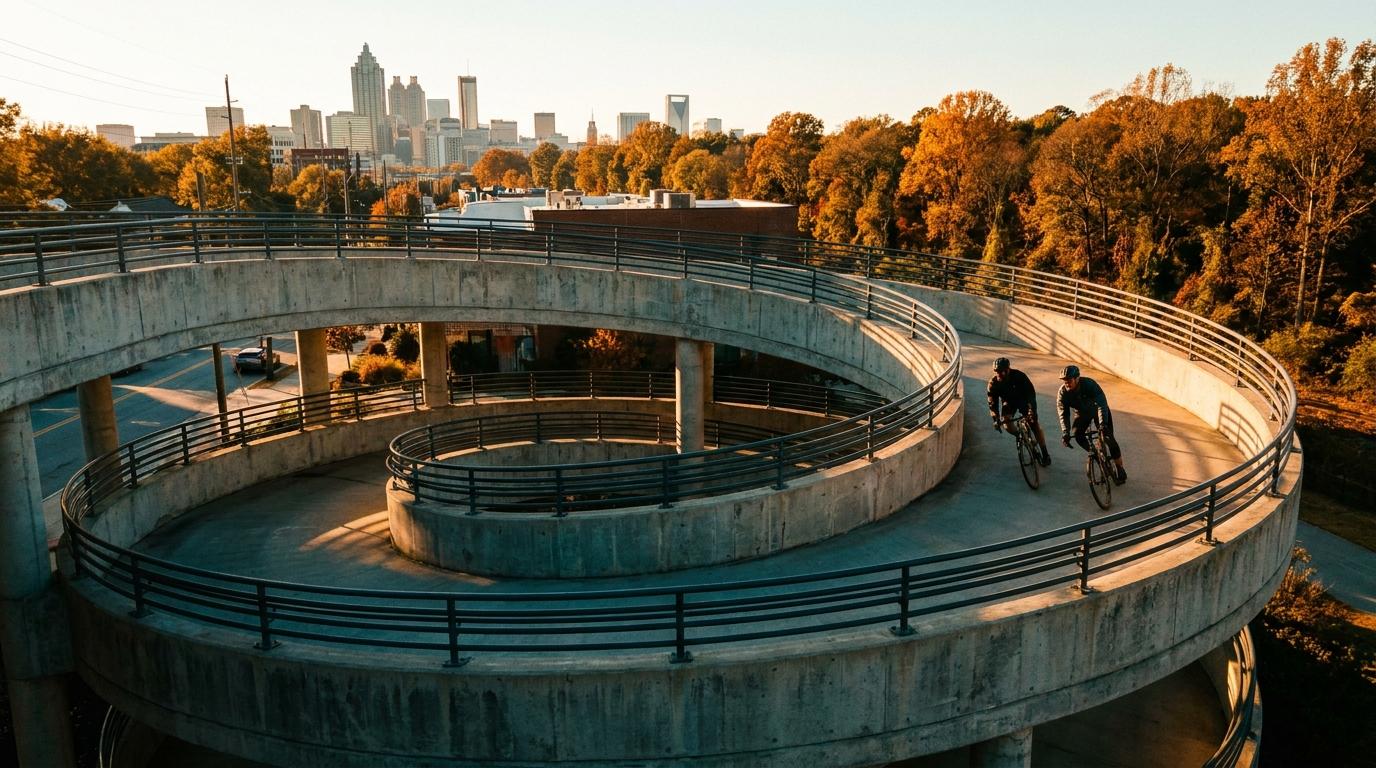
The Atlanta Beltline has a new piece of infrastructure that the internet has already named better than any planner ever could. The United Avenue access ramp on the Southeast Trail, a sweeping, banked spiral that drops riders and walkers from street grade down to trail level, landed this week, and locals on Facebook forums immediately tagged it the 'Mario Kart entrance.' The name is going to stick. It deserves to.

Before this ramp existed, the United Avenue access point was a dirt hill and rough stairs. Translation: it wasn't accessible, it wasn't safe in the rain, and it was the kind of half-measure infrastructure that told cyclists and pedestrians they were an afterthought. The new ramp is ADA-compliant, fluid, and, as the nickname confirms, actually fun to look at. That matters more than it sounds.
Why a Ramp Is Worth Your Attention
It's easy to scroll past 'Beltline ramp photos' and move on. Here's why you shouldn't.
The Southeast Trail has been the Beltline's longest-promised, most-delayed section, and it's finally punching through corridors that the Eastside and Westside trails never touched. United Avenue sits in a band of intown Atlanta neighborhoods (Ormewood Park, Glenwood Park, East Atlanta Village, Brownwood Park) that have been appreciating on the anticipation of Beltline connectivity for years. The ramp completing isn't just a punch-list item. It's a signal that the Southeast Trail is operational infrastructure now, not a construction zone with a finish date TBD.
For anyone who bought in Ormewood Park or Glenwood Park five years ago on the premise that the Beltline was coming: it's here. For anyone who has been watching those neighborhoods from the outside waiting for confirmation: this is a confirmation.
The Construction Read
I've spent twenty years on jobsites. When I see a ramp like this, I'm not just seeing a pretty curve: I'm reading the engineering decisions.
The United Avenue ramp addresses serious elevation change. Dirt hills and rough stairs get built when the budget is thin and the timeline is rushed. A full banked spiral with ADA-compliant grade, guardrails, and a smooth surface is the right call, and it's not cheap. The fact that the Beltline Authority funded this properly, rather than patching the old access with a basic concrete stair replacement, tells you something about where the Southeast Trail sits in the project's priority stack right now.

The guardrail design is also worth a second look. Double barriers on a sweeping elevated ramp aren't just safety theater: they're the right spec for the grade change involved and for the mix of cyclists, runners, and pedestrians sharing the surface. Whoever signed off on this didn't cheap out. That's notable on public infrastructure, where the value-engineering impulse is constant.
What the Southeast Trail Actually Does to Surrounding Real Estate
Let me be real with you about how Beltline connectivity moves neighborhood values.
The Eastside Trail is the most studied example in metro Atlanta. The BeltLine Affordable Housing Advisory Board's own data, along with multiple independent analyses, showed median home price appreciation in the 0.5-mile corridor around the Eastside Trail running 15-25% above broader Atlanta trends in the years immediately following trail opening. That's not the Beltline causing it alone, those corridors had other tailwinds, but the trail was a measurable accelerant.
The Southeast Trail's corridor is different terrain. You're looking at neighborhoods that are further along in their gentrification arc than Reynoldstown was in 2012, but still carrying meaningful value upside relative to comparable intown neighborhoods with established trail access. Ormewood Park single-family is trading in the high $400s to low $700s depending on condition and lot. Glenwood Park, which is a planned community built around the Beltline thesis from day one, has consistently commanded a premium that will only tighten as the trail becomes fully operational.
The neighborhoods south of there (Benteen Park, Brownwood Park, into the Boulevard Heights corridor) are earlier in the cycle. Those are the markets watching United Avenue closely right now.
The Broader Beltline Trajectory
Here's what I'm telling clients who are looking at intown Atlanta right now.
The Beltline is not a finished project. It's a 22-mile loop and significant sections are still under construction or in planning. Every time a new segment opens, every time a punch-list ramp or bridge or lighting installation completes, the project gets closer to its full network effect. A trail that connects to nothing is a trail. A trail that connects to 22 miles of continuous loop infrastructure is an urban asset that changes how the city functions.
United Avenue completing its ramp is a small thing. But small things that close gaps in critical infrastructure are not actually small. Every connection that comes online makes the case stronger for every neighborhood still waiting for its segment.
If you're buying intown and you're not tracking Beltline segment completion as a factor in your location decision, you're missing one of the clearest value signals the Atlanta market produces.
Now you know where to look. Send the address. Beckett Real Estate will tell you what the trail access timeline actually means for that specific block.
Thinking about a move?
Beckett Real Estate works the whole of Metro Atlanta. Tell me the address or the neighborhood and I will tell you what the house is really like, what the inspection usually finds, and what the number should be.
See homes for saleTalk to an agent nowMore articles like this