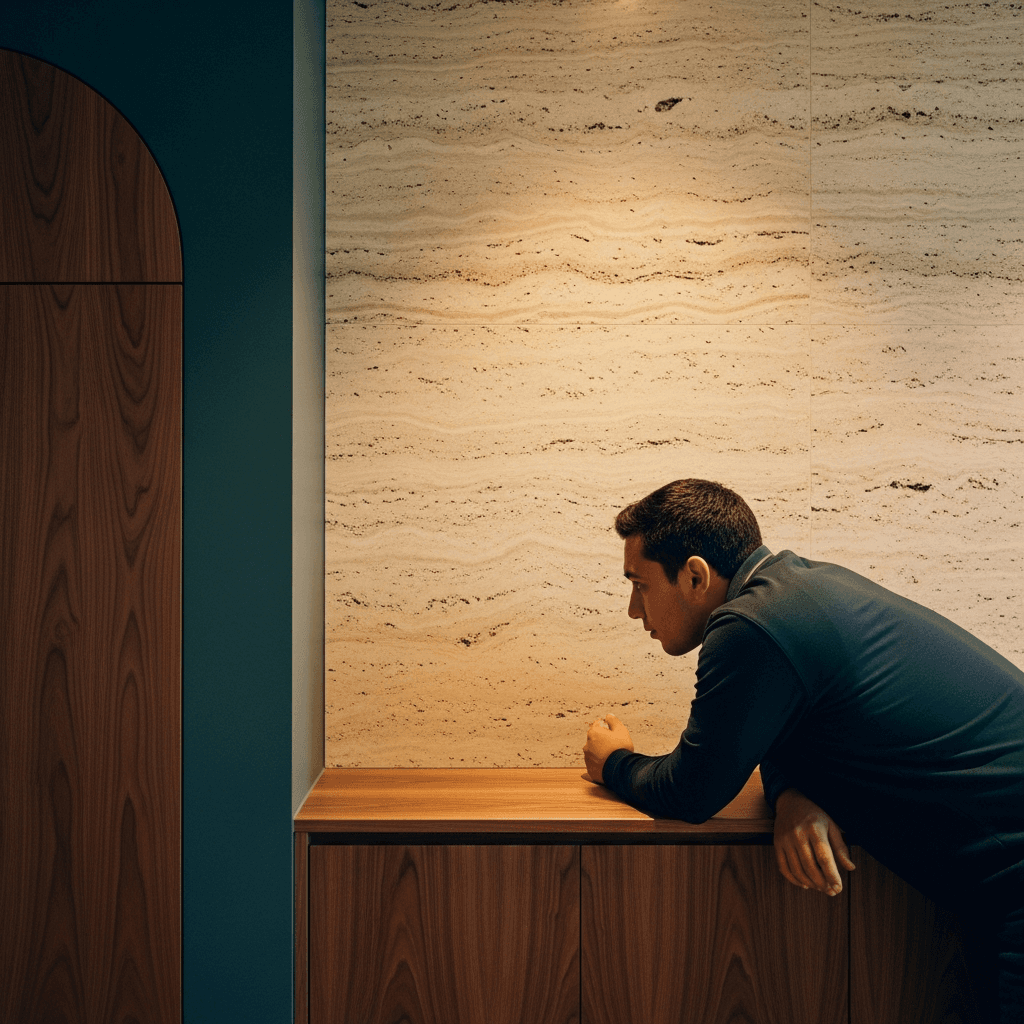
There's a building in Huizhou, China (a late Qing Dynasty study that sat abandoned long enough to be officially condemned as hazardous) that was just brought back as a meditation art space. The architects kept the original grey brick skin, preserved the fragments of wooden mezzanine still clinging to the walls, and left the staggered window openings exactly where they were cut two centuries ago.
Then they did something that most new construction in Atlanta couldn't pull off if you handed the builder a blank check: they engineered the light.
Not the fixtures. The light itself. Warm gold inside the study. Cool natural light in the courtyard. Two atmospheres occupying the same structure, creating a spatial tension that makes you feel the passage of time just by moving through a doorway.
I've been thinking about this since I first pulled the images.

The Thing Atlanta Builders Get Wrong About Light
In twenty years working across construction — running electrical, installing HVAC duct systems, walking buildings from framing through final inspection — I watched the same mistake repeat itself on almost every residential build: light was treated as a utility, not a material.
The question was always 'is there enough of it?' Never 'what is it doing to the room?'
So you get what metro Atlanta mostly has: six-inch recessed cans on a single-pole switch, all at 4000K because the electrician ordered the same case he ordered last week, positioned on a 4-foot grid because that's what the plan called for. The room is bright. The room is flat. The room has no atmosphere whatsoever.
The Qing study in Huizhou has the opposite problem and arrived at the opposite answer. Prior to the restoration, the building was 'perpetually enveloped in dim, atmospheric natural light', the architects' own words. Their intervention didn't add recessed cans. It sculpted what was already there. Warm installations inside. Cool courtyard light untouched. The contrast between the two is the design.
That is the move. That is what the best interior designers in Atlanta are starting to understand and what the volume builders haven't caught up to yet.
Warm vs. Cool: What the Contrast Actually Does
This isn't abstract theory. It's spatial psychology, and once you understand it, you can't unsee it in every room you walk into.
Warm light (2700K-3000K) compresses a space. It makes a room feel intimate, inhabited, like someone lives there and cares about it. It's the light over a kitchen island at 9pm, the reading lamp in the study, the sconce flanking the fireplace. It signals that you are in the private interior of the house.
Cool light (4000K-5000K) expands a space. It reads as exterior, transitional, daylit. It belongs in the utility zones (the laundry room, the garage, the mudroom) or in covered outdoor spaces that are meant to feel like an extension of the yard rather than a room of the house.
The magic is in the contrast. When you move from a cool space into a warm space, your nervous system relaxes before your brain processes what happened. You felt that in the last restaurant that made you want to stay for a second glass of bourbon. They knew what they were doing. The Qing study architects knew what they were doing. The builder who installed a single case of 4000K cans throughout your entire house did not.

What This Looks Like in a Real Atlanta Home
Here's how to apply the principle without gut-renovating your electrical panel.
The fastest fix: swap the bulbs. Every living room, dining room, primary bedroom, and study should be running 2700K maximum. If your current bulbs are 3000K or higher, you're living in a showroom, not a home. A four-pack of Philips Hue warm-white dimmables runs about $40. This is the cheapest high-ROI move in residential design.
The medium fix: add a second source. If the room currently has only overhead light, add a floor lamp or a table lamp in the far corner. Two sources at different heights and angles create depth. One source from the ceiling creates a hospital corridor.
The right-way-to-build-it fix: design the contrast intentionally. In a new build or a renovation, this means the covered porch uses a different temperature than the great room. The butler's pantry reads cooler than the dining room. The powder bath is the one place in the house where you can run 3500K and call it a design choice. Every other room with a chair gets warm light.
The Huizhou study used 200-year-old architecture as the light-sculpting instrument. You've got LED drivers and smart switches. The principle is identical.
The Temporal Layering Piece
There's a second thing the architects described — 'stratified readability of temporal traces' — that's worth sitting with.
They preserved visible evidence of different eras of the building's life: the original grey brick skin from the Qing construction, the earthen interior wall behind it, the fragments of wooden mezzanine that didn't fully decay, and their own contemporary intervention layered over all of it. You can read the building's history in its walls the same way you can read a tree's age in its rings.
This runs directly counter to how most Atlanta renovation projects approach old material. The reflex is to cover it. Fresh drywall over old plaster. New LVP over original hardwood. A coat of paint over brick that took a century to develop its patina. The instinct is to make the house look 'new': as if newness were the virtue.
The better instinct, and the one that produces houses worth photographing, is to ask: what does this material know that new material doesn't? Old brick has mass. Original hardwood has grain variation that milled-to-order stock will never have. A plaster wall has imperfection that reads as humanity. You don't have to expose all of it. But covering all of it is always the wrong answer.
I've walked enough properties in this market to tell you: the houses that hold their value across market cycles are almost always the ones that kept the material. The spec-builder flip that drywall'd over the original brick fireplace, re-floored in LVP, and painted everything the same agreeable grey. It looks fine in the Zillow photos and feels like nothing when you're standing in it.
The study in Huizhou will still be worth experiencing in thirty years. Most new construction in metro Atlanta won't be worth photographing in ten.
Take her there. Show her what warm light does to a room. Then go home and change the bulbs.
Thinking about a move?
Beckett Real Estate works the whole of Metro Atlanta. Tell me the address or the neighborhood and I will tell you what the house is really like, what the inspection usually finds, and what the number should be.
See homes for saleTalk to an agent nowMore articles like this