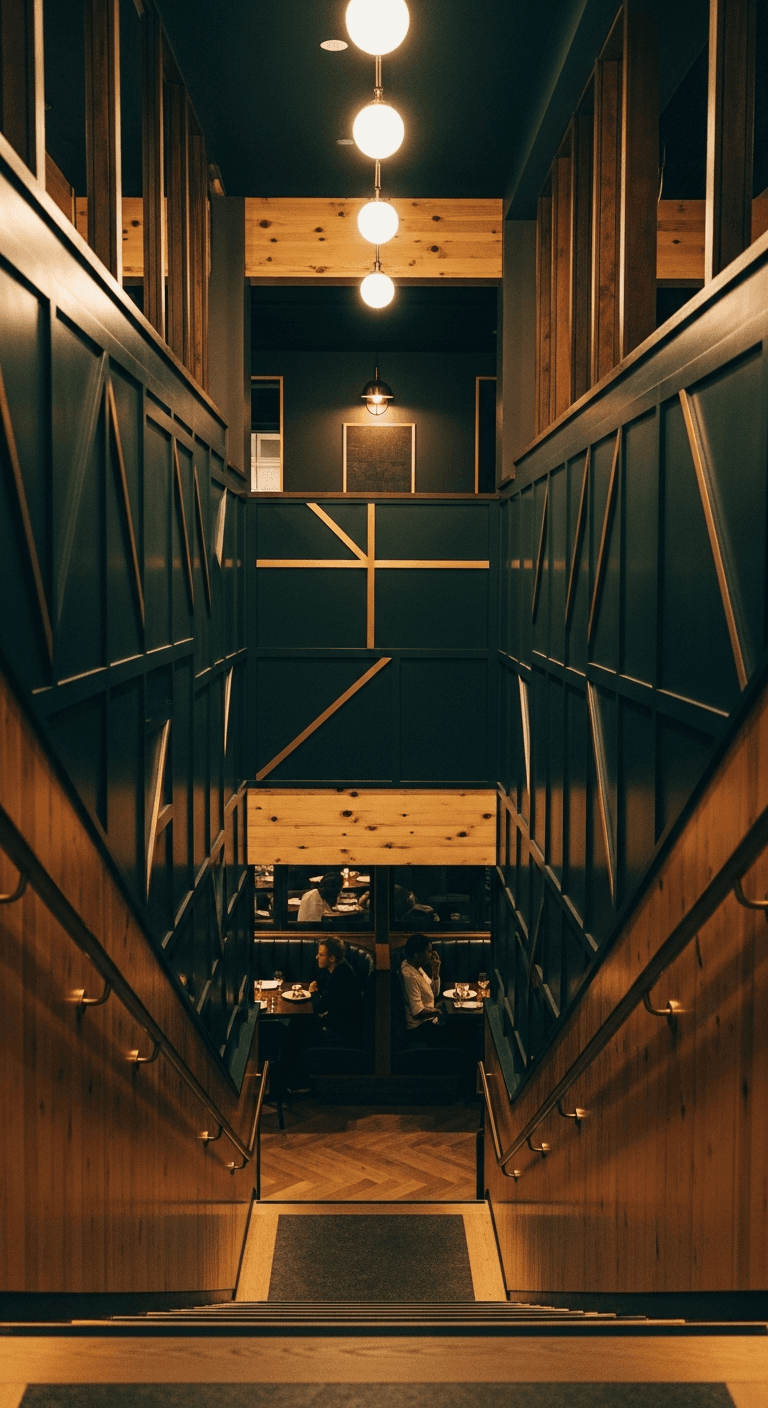
There is a coffee lab in Baoshan, China that is getting more architecture press right now than most Atlanta restaurants will ever see. No10-Architects designed it for Voiceless Coffee (a local institution that runs the full chain from cultivation to training), and the brief was to translate multi-dimensional flavor sensory experience into architectural spatial design.
That phrase sounds like architecture-school word salad. It is not. It is actually the most honest brief a designer can get, and the result is worth pulling apart because it explains something about why most rooms fail and a few rooms work.

The Brief Most Atlanta Renovations Never Ask
Here is what almost every Atlanta kitchen and living room renovation actually asks for: 'Make it look nicer. White oak floors. Quartz counters. Maybe a tile backsplash that is interesting but not too interesting.'
That is a cosmetics brief. It produces cosmetics results: a room that photographs better than it lives, a kitchen that feels like it could belong to anyone, a space that has nothing to say because nobody asked it to say anything.
Voiceless Coffee asked something different. They asked: what does the body do in this room? What do your eyes find first? Where does the brain quiet down enough to actually pay attention to what you are tasting? How does the architecture serve the experience of smell and flavor rather than just the experience of looking at the room?
That is a spatial brief. And the gap between a cosmetics brief and a spatial brief is the same gap between a builder house and an architect house, which I wrote about a few weeks ago when I went through the millwork question. The tell is almost always in how the room teaches you where to look.
What Sensory Architecture Is Actually Doing
The Sensory Lab uses a few moves that Atlanta residential design borrows badly and commercial design almost never attempts correctly.
Compressed entry, released interior. You come in through a tight space. The ceiling is lower, the light is dimmer, the path is narrow. Then the room opens. Your nervous system responds to that transition before your conscious mind registers it: you exhale, your shoulders drop, you are actually present in the space rather than just occupying it. The best Atlanta houses do this. Most builder houses walk you straight from the front door into a two-story foyer that announces square footage rather than sequence.
Material transitions that telegraph program. In a sensory-driven space, the floor changes when the function changes. The material at the counter where you are tasting is different from the material where you are waiting. That transition is not decorative. It is instructional. It tells your body what mode to be in before anyone says a word. This is the move that most Atlanta open-concept renovations destroy by accident: pulling the same white oak from the entryway through the kitchen and into the living room, eliminating every material transition in the name of flow, and producing a room that has no program and no sequence.
Light as architecture, not illumination. The lab's photography shows a lighting scheme where you can identify the single direction light is coming from. There is a source. There is a direction. There is shadow as a design element rather than a problem to solve with more can lights. This is the difference between a room that has depth and a room that is uniformly bright and completely flat. In 20 years running construction on commercial projects (data centers, transit stations, office parks), the lighting plan was always where the difference between a beautiful space and a merely adequate one showed up. Residential gets this wrong at a much higher rate than commercial.

The Atlanta Translation
None of this requires a 50,000-square-foot lab in Yunnan. Here is what the spatial brief looks like applied to a renovation in Decatur or East Cobb or Peachtree City:
Ask the sequence question first. Walk in your front door and trace every step to your kitchen. What do you see? What is the first room asking you to feel? If the answer is 'nothing in particular,' you have a cosmetics brief masquerading as a design brief. Fix the entry sequence before you touch the counters.
Kill at least one light source. Pick a room and remove the center ceiling fixture entirely. Replace it with two or three directed sources (a pair of sconces, an under-cabinet strip, a reading lamp in the corner) and watch the room become a different room. You are not adding light. You are adding direction, and direction produces depth.
Pick one material transition that means something. The living room floor to the kitchen floor. The kitchen counter to the island. The hallway to the primary bedroom. One transition, consciously chosen, where the material changes because the function changes. That is the smallest move with the largest spatial return.
The Voiceless Coffee Sensory Lab will get written about in architecture publications for years because it asked a better question. Most Atlanta renovations ask 'what do we put in.' The better question is always 'what does the room do to the person inside it.'
Take her there. Order what the bartender drinks. Thank me later.
Thinking about a move?
Beckett Real Estate works the whole of Metro Atlanta. Tell me the address or the neighborhood and I will tell you what the house is really like, what the inspection usually finds, and what the number should be.
Estimate your renovation costSearch homes for saleTalk to an agent nowMore articles like this