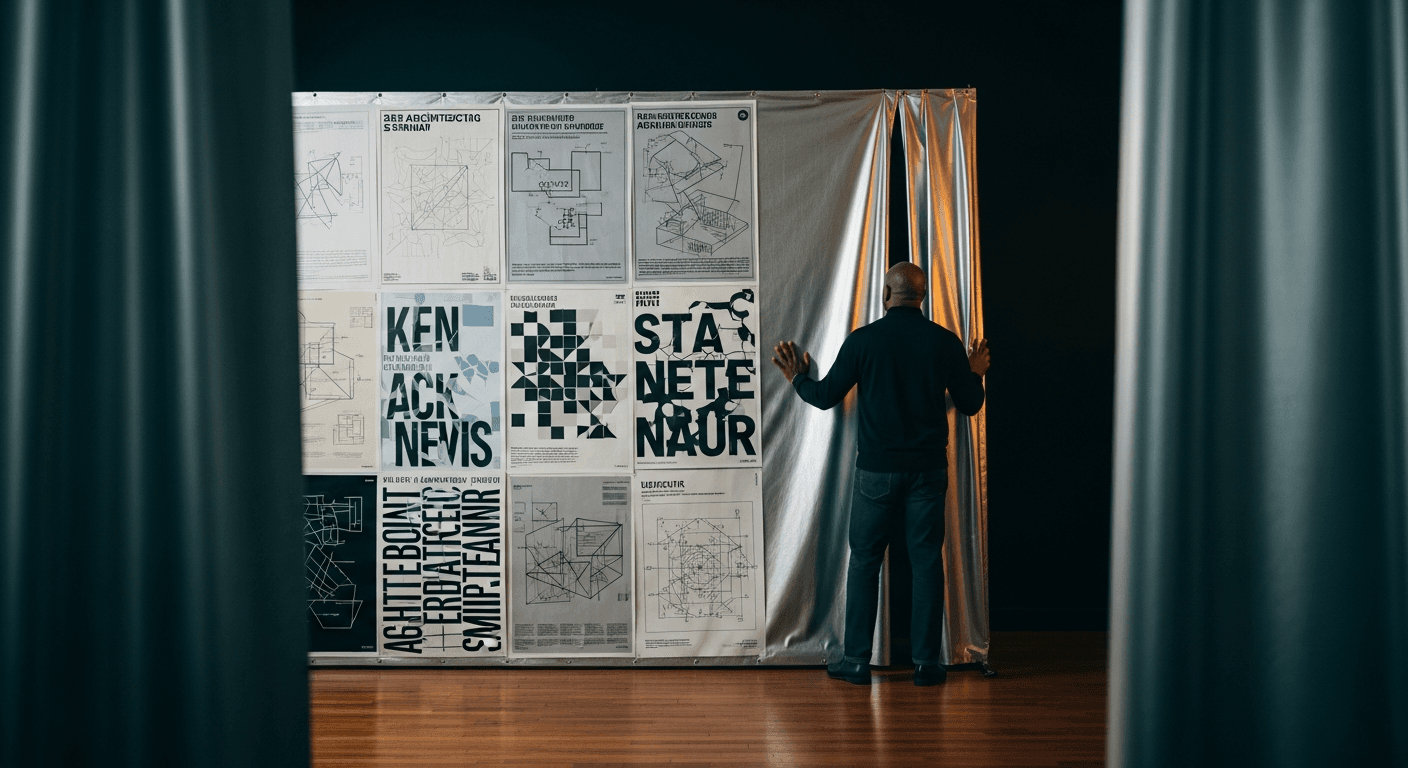
There's a show up at Princeton right now marking 25 years of the Media + Modernity seminar, and the design choice they made to display it is the part worth talking about.
Instead of the usual retrospective setup (framed prints, chronological wall panels, museum lighting), they hung a silver fabric curtain and printed the seminar posters across it. All 25 years of them, layered onto one surface.
That's a deliberate statement about how we hold information. Not as a timeline you walk through. As a texture you stand in front of.
Beatriz Colomina, who's directed the program for most of that run, made this choice with her co-curators. And if you know Colomina's work (she's spent decades writing about how media shapes our understanding of architecture, how a photograph of a house changes what we think the house means), then the curtain isn't decoration. It's the argument.
Here's what this gets right that most design retrospectives get wrong: a flat, chronological display implies progress. One idea leading to the next, getting better, more refined. The curtain refuses that. It says: all of this is happening at once. The ideas don't stack. They accumulate.
For anyone who thinks about interiors and how to display collections (art, objects, even books), there's a real lesson in this. The format of display is itself an editorial decision. The chronological gallery wall is a choice that says 'this is a story with a beginning and an end.' The layered curtain is a choice that says 'this is a living body of thought.'
Most people don't think that consciously when they're arranging a shelf or hanging artwork. They should.
Thinking about a move?
Beckett Real Estate works the whole of Metro Atlanta. Tell me the address or the neighborhood and I will tell you what the house is really like, what the inspection usually finds, and what the number should be.
See homes for saleTalk to an agent nowMore articles like this