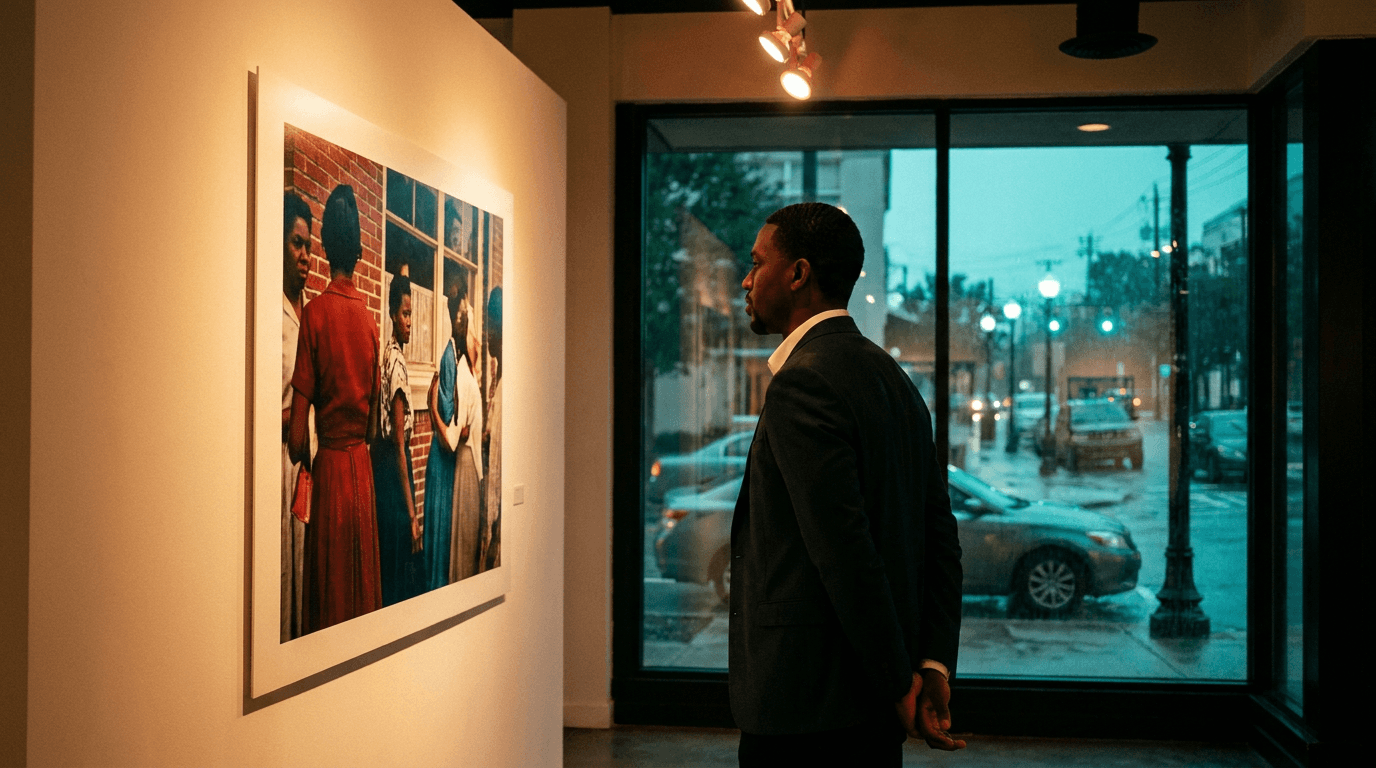
There is a reason Gordon Parks shot the South in color.
Black-and-white photography had become the visual grammar of civil rights documentation by 1956. It flattened everything into abstraction: history-in-the-making, tragedy at a comfortable aesthetic remove. Parks looked at the same Alabama and said: no. These are real people living in a real place with real color in their lives, and you are going to see exactly that.
The result is a set of photographs that do not let you look away and tell yourself you are looking at the past.
'Gordon Parks: The South in Color' is on view at Jackson Fine Art in Buckhead through June 13. More than 30 photographs from his 1956 Life magazine commission. If you have not been, that is the only thing you need to know to make the call.
Why This Exhibition Hits Different in Atlanta
Jackson Fine Art has been one of the serious photography galleries in the American South for over thirty years. They do not book things for novelty. When they put Parks on the wall, they are making a statement about what photography at this level of intention actually does to a room.
Atlanta is a specific place to be looking at these images. This is not a New York gallery showing the South as artifact. This is Atlanta: a city that built its entire post-civil rights identity on forward momentum, on being the exception, on being 'the city too busy to hate.' Parks' photographs are not interested in letting that self-image go unexamined.

The color is the mechanism. Parks photographed Willie Causey and his family in Shady Grove, Alabama: the specific faces, the specific dresses, the specific light coming through a window in a specific house. Color photography in 1956 was expensive and deliberately chosen. Parks chose it because he understood that segregation depended, in part, on abstraction. On the ability of white Americans to think of Black Americans as a category rather than as people with particular faces and particular lives.
He took that abstraction away.
What You Are Actually Looking At
The 1956 Life assignment was titled 'The Restraints: Open and Hidden.' Parks embedded himself with the Causey family in Alabama during the period immediately following the Montgomery Bus Boycott. The state of Alabama had just brought legal action against the NAACP. The photographs he made during that assignment document daily life under a system of terror (schools, churches, waiting rooms, storefronts) in full color that refuses to let any of it become a symbol.
This is documentary photography working at the highest level of craft and moral intelligence simultaneously. Parks was not making images for posterity. He was making images for the readers of Life magazine in 1956 who had the option not to think about what was happening ninety miles south of Atlanta.

The exhibition runs through June 13. That gives you roughly six weeks, which sounds like enough time and rarely is.
The Atlanta Context You Should Not Miss
Jackson Fine Art sits in Buckhead at 3115 East Shadowlawn Avenue. It is not a gallery that announces itself. It is the kind of place you go to when you know where you are going. The space is well-suited to large-format photography: good light, serious walls, the kind of quiet that lets you actually look.
The gallery has been booking significant photography exhibitions for decades. Parks belongs here in the sense that the work demands a room with the right scale and the right seriousness. This is not a pop-up. It is not a hotel lobby installation. It is thirty-plus photographs that were made with full understanding of the risk Parks was taking by being in Alabama in 1956 and making images that told the truth about what he found there.
Atlanta in the spring of 2026 is a particular moment to be standing in front of these photographs. Whatever you make of the current national conversation about history and memory and who gets to tell which stories, Parks answered that question with a camera in 1956, and the answer is in that room on East Shadowlawn.
A Note on What 'Reminder' Actually Means
The exhibition subtitle positions the work as 'a reminder of past and present racial realities.' That framing is accurate but incomplete. Parks' photographs are not primarily a reminder. They are evidence.
There is a difference. A reminder assumes you knew something and forgot it. Evidence does not make that assumption. Evidence asks you to look at what is in front of you and form a judgment based on what you actually see.
Parks understood this distinction better than most photographers of his generation. He chose color because color makes the evidence harder to file away as history. He chose specific people (the Causeys, named and photographed as individuals) because individuals are harder to abstract than categories.
That is still the work these photographs are doing in a gallery in Buckhead in 2026. The question is whether you are willing to go stand in front of them and let them do it.
Jackson Fine Art. 3115 East Shadowlawn Avenue, Buckhead. Through June 13. Go before the June heat makes everything feel like an errand.