There's a version of watch collecting that never fully works for a lot of guys, and nobody in the industry talks about it honestly. The Speedmaster Moonwatch is one of the most iconic pieces ever strapped to a human wrist. NASA put it on astronauts. It went to the moon. It's a legitimate piece of mechanical history. But at 42mm, with lug-to-lug dimensions that push past most guys' comfort zone, a lot of people who should own one never pull the trigger. They try it on, it hangs over both sides of the wrist, and they walk out of the boutique feeling like the watch made the decision for them.
Omega just changed the math.

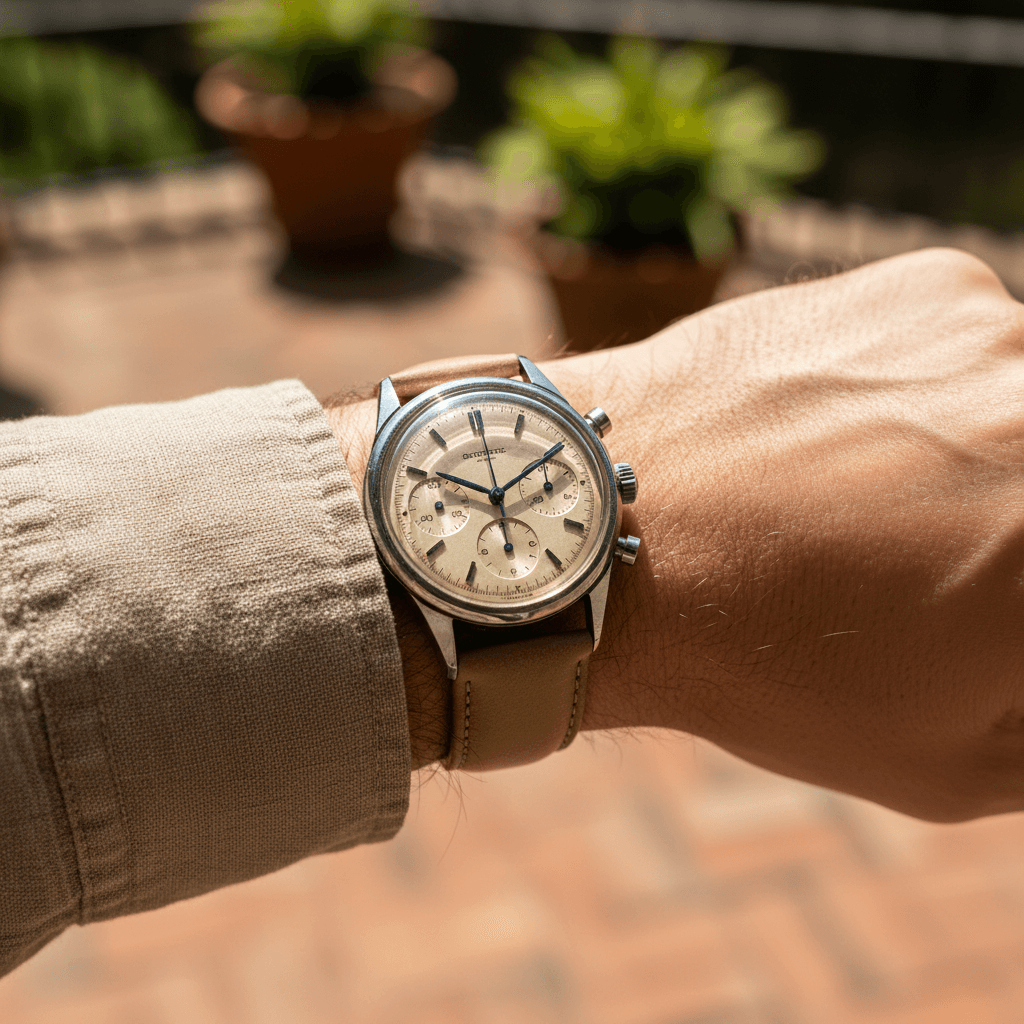
Seven new 38mm Speedmaster models hit the lineup, and the design team made a choice worth paying attention to: they moved away from oval subdials and toward the classic circular subdial layout that defines the original Moonwatch aesthetic. That's not a small tweak. That's a structural design realignment: the 38mm is no longer the 'smaller watch that sort of looks like a Speedmaster.' It's now a Speedmaster that fits a smaller wrist.
Why the Subdial Change Matters More Than the Size
Most people are going to read this as a story about proportions. Smaller case, fits more wrists, good for guys who don't wear 44mm everything. And that's true. But the more interesting move is what Omega did to the face itself.
The oval subdials on prior 38mm models were a visual tell. Even if you loved the watch, the layout read as 'inspired by the Moonwatch' rather than 'this IS a Moonwatch.' Watch guys noticed. The circular subdials on these new models close that gap. You're now looking at a Speedmaster, not a tribute to one.
For the guy who's been waiting for an on-ramp into the Speedmaster family without the case dominating his wrist, this is the most legitimate version of that on-ramp the brand has ever offered.

The seven models cover enough ground to give the lineup real range: different dials, different metals, different bracelet configurations. Omega isn't dropping one 38mm and calling it a day. This feels like a genuine collection buildout rather than a limited-run experiment to test the market.
The Honest Take on Who This Is For
Let's skip the usual watch-media framing where every new release is positioned for 'the discerning collector who appreciates heritage and craftsmanship.' That's not a person. That's a press release.
Here's who this is actually for:
The guy who's been into the Speedmaster for years but has a genuinely smaller wrist — 6.5 inches or under — and found the 42mm pushed past the point where he felt comfortable. He doesn't need to be talked into the history of the watch. He knows the history. He just needed Omega to build him the right one.
The guy who wears a 38-40mm across his whole collection and has been looking at the Moonwatch section of every dealer's case thinking 'one day when I decide I'm okay with big.' He doesn't have to decide that anymore.
And honestly, the guy who's newer to watches and has heard enough to know the Speedmaster matters, but who tried one on and felt overwhelmed by the proportions. This is a more approachable point of entry, and 'approachable' here doesn't mean cheap or compromised. The movement is real. The history is real. The case is just calibrated to actual human wrists.

What I'd Actually Do
If I'm in the market for this watch, I'm not rushing to a boutique in the first 30 days. The enthusiasm spike that follows a launch announcement always settles. Give it six to eight weeks, try on whichever two or three references speak to you in person (different dials read completely differently on the wrist than on a product shot), and buy the one you'd still be happy wearing in ten years.
The Moonwatch DNA has earned its staying power. These seven references are the first time that DNA has been packaged for a wider audience without feeling like a compromise. That's worth taking seriously.
Go try one on. You'll know immediately whether it's the one.