There's a version of this appetizer on every Southern Living scroll right now, and most people are going to make it wrong.
Not because the recipe is hard. Because they're going to think about it as an onion dish with cheese on top. It isn't. It's a cheese crisp that happens to be built around onions, and the moment you understand that distinction, you stop making a soggy mess and start making something that disappears inside of three minutes at any gathering you bring it to.
I've been cooking for two teenagers for years. I don't have patience for fussy. This one is genuinely not fussy. But it rewards the one or two decisions you make before the pan goes in the oven.
The Decision That Actually Matters: The Cheese Stack Order
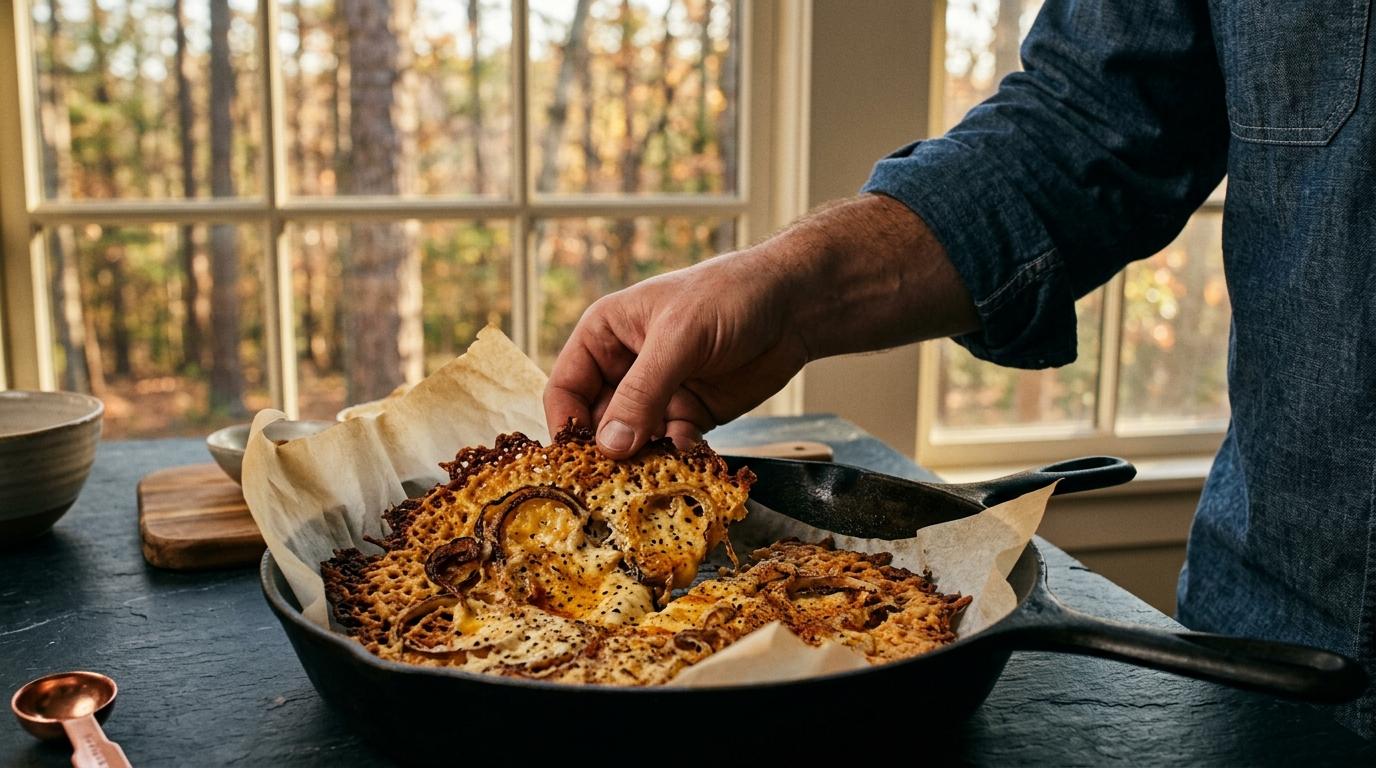
The recipe logic here is the opposite of what your instincts say. You build it cheese-down: Parmesan first on the parchment, then your Cheddar and Gouda in the middle, onion rings on top of that, spice blend over the onions, then a final snow of Parmesan to cap it. The bottom layer of Parmesan is doing the structural work: it's going to lace and crisp against the parchment and become the scaffolding everything else rests on.
If you invert this (onions first, cheese over the top), you get a different product. The moisture from the onions as they cook steams the cheese instead of crisping it. The bottom never gets that dark, lacy, almost-burnt edge that makes people reach across you to grab another piece.
The Gouda in the middle is doing something specific too. It has more moisture and a lower melting point than the aged Parmesan. It's the layer that melts and bonds, where the Parmesan provides the crisp frame. Three-cheese stacks where all three have the same melt profile tend to go either greasy or rubbery. This one doesn't, because the cheeses are pulling different jobs.

The Mandoline Is Not Optional
I know. Nobody wants to deal with the mandoline. Get the cut guard, go slow, do it anyway.
You need 1/16-inch rings. That is thinner than a knife can reliably do in any volume. At that thickness, the onion rings cook down and become almost translucent, part of the cheese crisp, not a separate layer sitting on top of it. At 1/8-inch or thicker (what you get freehanding with a knife), the onion holds its moisture longer and fights the crisp you're trying to achieve.
Sweet or yellow onion. Not red: the sulfur compounds in red onion don't play well with the smokiness of the Gouda and the salt of the Parmesan. Sweet onion is the Georgia move anyway. Vidalia season is right now, and if you've got a Vidalia on the counter, use it.
What You're Actually Serving, and When
This is the appetizer that works in the gap that most entertaining fails in: the twenty minutes between 'people arrive' and 'actual food is ready.' Most hosts put out a charcuterie board. Charcuterie boards are fine. This is better, because it's warm, it smells incredible when it comes out of the oven, and it requires exactly zero assembly on the counter while you're also managing guests.
Batch it in advance. The full bake is 18-20 minutes at 400°F. Let it rest five minutes, loosen it in one piece, then break it into shards or cut it into squares. Keeps its structure at room temperature for about twenty minutes before it starts to soften. In a Georgia August, plan accordingly: cooler kitchen, later pull.
The ranch is not decoration. A real buttermilk ranch with some black pepper cuts the richness of three cheeses and the sweetness of the onion exactly right. Hidden Valley from the packet is not what I'm talking about. Make the buttermilk version, or buy one from a local barbecue spot that makes it in-house. The difference is obvious.

The Spice Blend Is a Five-Minute Upgrade Worth Making Your Own
The recipe calls for dried parsley, dry mustard, salt, black pepper, garlic powder, and smoked paprika. That's a good baseline. It's also the version where you can do exactly one thing to make it noticeably better: swap standard smoked paprika for Bittersweet Spanish smoked paprika (Pimentón de la Vera, Dulce or Agridulce), and add a pinch (not more than a pinch) of cayenne to the mix.
The standard smoked paprika is fine. The Spanish pimentón has a deeper, almost bacon-adjacent smoke character that reads as intentional and considered versus 'I followed the recipe.' A 2-ounce tin runs about $7 at Whole Foods or any decent grocery with a spice section. You'll use it again.
The cayenne is about contrast. Three cheeses with sweet onion is rich, warm, and slightly sweet. A small heat note at the back keeps people reaching. It's not a hot appetizer. It's an appetizer where the next bite sounds like a good idea immediately after the first one.
One More Thing: The Pan Matters More Than You Think
Heavy-gauge rimmed baking sheet. Not the thin aluminum pan that came with your oven. A thin pan conducts heat unevenly. You'll get burnt edges and underdone centers before the cheese has fully crisped across the whole surface. A quality half-sheet pan (Nordic Ware is the reliable choice in the $20-25 range; the commercial-grade ones from a restaurant supply store in Atlanta are better and barely more expensive) solves this entirely. It's the same logic as a cast-iron skillet versus a thin nonstick: the mass of the pan is doing work for you.
Parchment, not foil. The cheese needs to release cleanly when you loosen it. Foil tears and takes cheese with it.
That's really it. Pan, cheese order, mandoline, good paprika. Four decisions on a recipe that takes thirty minutes start to finish.
Make it this weekend. Bring it to someone's house. Watch how fast it goes.
Thinking about a move?
Beckett Real Estate works the whole of Metro Atlanta. Tell me the address or the neighborhood and I will tell you what the house is really like, what the inspection usually finds, and what the number should be.
See homes for saleTalk to an agent nowMore articles like this