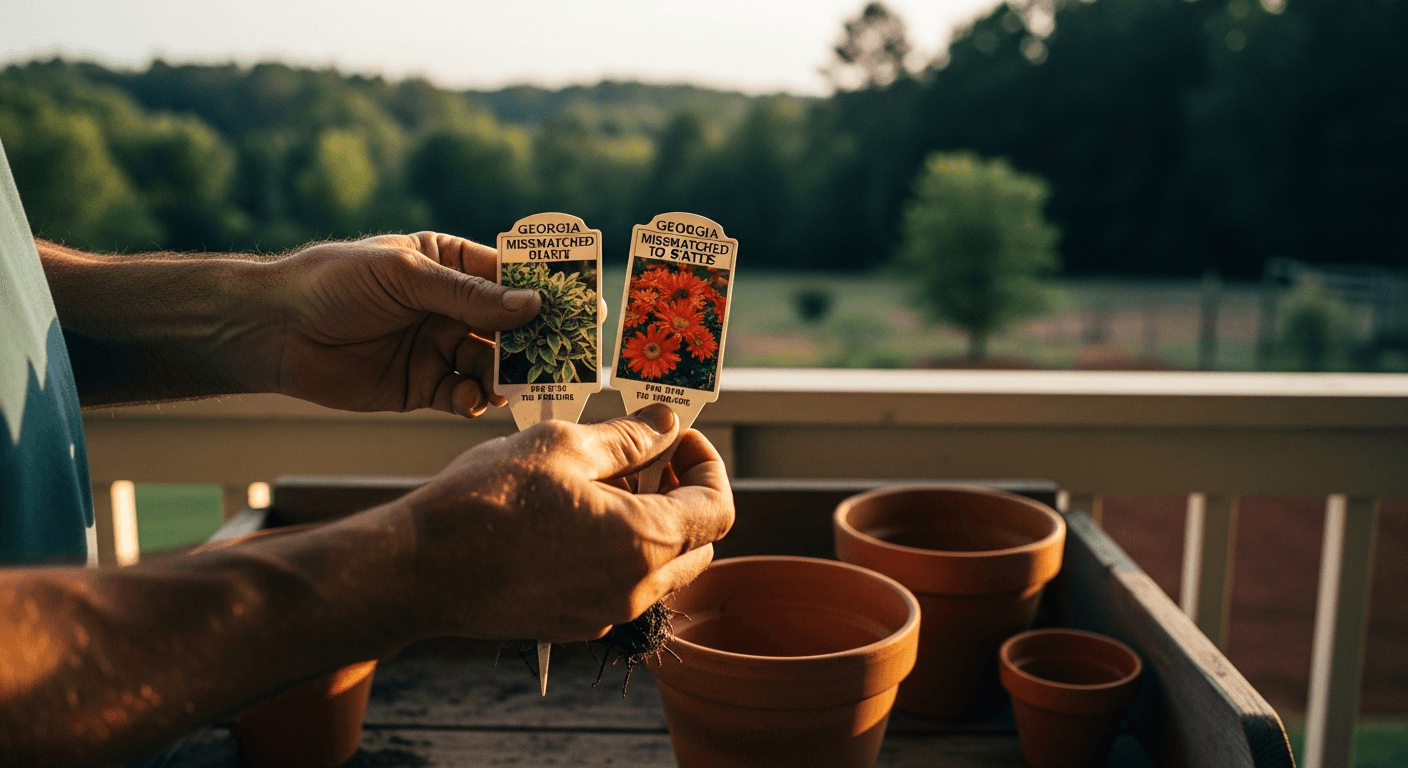
There's a gardening post making the rounds right now: a woman documenting what she calls her 'accidental potted garden experiment.' No grand plan. Just pots, trial and error, and honest notes on what went sideways.
I read it differently than most people probably did.
Because every single lesson she landed on (mislabeled products, hidden growth points you have to remove, plants that looked dead but weren't), I've lived those same lessons on job sites. Different scale. Same principles.
Three of them stuck with me enough to write this.
Lesson 1: Never Trust a Label
She bought two tomato plants at a nursery. Same tag on both. One turned out to be a completely different variety: wrong label, wrong plant, nobody caught it until it was growing.
I've watched the same thing happen on commercial construction sites and residential builds alike. Spec sheet says one product. Box on the pallet says the same thing. What's actually inside is last year's model, or a substituted-in alternative the supplier swapped without notice.
The project manager's job (my job, for 20 years) was to verify before it went in the wall. Because once it's in the wall, the cost of discovering the swap triples.

This matters for homeowners doing any kind of DIY work: the SKU on the shelf and the product in the box are not always the same. Paint sheens get swapped. Caulk formulations vary by production run. PEX fittings come in incompatible size standards that look identical until they leak.
Verify what you actually have before it goes in. Read the actual product label, not the shelf tag.
Lesson 2: Suckers Will Take Over If You Let Them
The post had a section on cucumber suckers — those secondary shoots that grow between the main stem and the leaf node. Leave them alone and the plant sprawls, loses energy, produces less. Pinch them off and the plant focuses its resources on the main stem.
Same exact principle in HVAC.
When I was running duct systems early in my career, physically fabricating and installing ductwork across commercial buildings, the number one efficiency killer wasn't equipment spec. It was branch runs that weren't properly sized or dampered. Energy bleeds into the path of least resistance. The main run gets starved. The rooms that need conditioning most get the worst airflow.
You have to manage where the system's energy goes. That's true whether you're growing cucumbers or conditioning a large office floor.

For a homeowner: if certain rooms in your house run hot or cold no matter how you set the thermostat, you may have a 'sucker problem' in your duct system. Undersized branches, improperly balanced dampers, duct leakage at joints. The equipment is working. The distribution is bleeding off where it shouldn't.
That's a diagnostic conversation worth having before you spend money on a bigger unit that won't fix anything.
Lesson 3: What Looks Dead Might Just Be Dormant
The part of the post I liked most: she found Bells of Ireland she'd planted the prior year, left in the ground over winter, and they came back. She didn't expect it. She'd written them off. They had other plans.
Here's what 20 years in construction teaches you about buildings: the ones that look the worst on the surface are sometimes the ones with the best bones.
I've walked REO properties (bank-owned foreclosures) that looked genuinely terrible. Overgrown. Deferred maintenance stacked on deferred maintenance. The kind of listing that most agents won't touch and most buyers won't look at twice.
And I've walked inside and read the framing, the roof structure, the mechanical systems (the actual bones) and seen something different than what the surface suggested. The structure was sound. The systems were aged but functional. What looked like a write-off was actually a significant opportunity at the right price.

The reverse is also true, and I've seen that more. Properties that present beautifully (fresh paint, new fixtures, staged to the nines) hiding deferred maintenance in the systems nobody thinks to look at. New carpet over a crawlspace with moisture issues. Fresh drywall over framing that never got fixed. Dormant problems that look very much alive.
The surface is always the last place I look. The bones are where the story is.
The Takeaway
Gardening, construction, real estate — the same few lessons keep showing up in different clothes.
Verify what you actually have. Manage where the energy goes. Don't mistake surface condition for structural reality.
The woman writing that post was talking about pots on a back porch. I'm talking about the biggest purchase most people ever make. But the discipline is identical: pay attention to what's actually happening, not just what the label says.
Send the address. A construction-trained walk-through is what tells you whether the price reflects the condition or papers over it.
Thinking about a move?
Beckett Real Estate works the whole of Metro Atlanta. Tell me the address or the neighborhood and I will tell you what the house is really like, what the inspection usually finds, and what the number should be.
Explore new constructionSearch homes for saleTalk to an agent nowMore articles like this